
















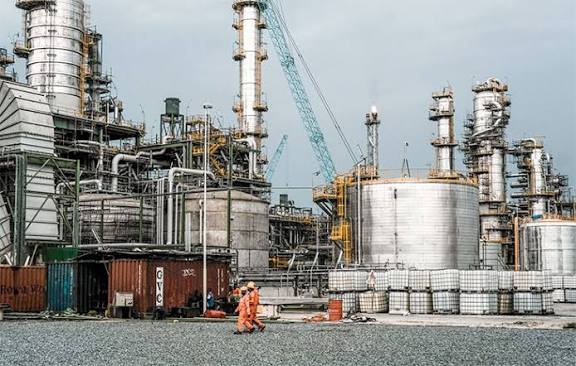
Dangote Petroleum Refinery has disclosed that the company is currently discussing with the Federal Government and the Nigerian National Petroleum Company Ltd. (NNPCL) to increase the proportion of crude supplied under the naira-for-crude policy.

Chief Executive Officer of the company , Mr. David Bird, disclosed this at a press conference on Wednesday, emphasized the need for the Federal Government and industry regulators to strengthen its implementation in the country. The Naira-for-Crude policy is Nigeria’s initiative to sell crude oil to local refineries in Naira (not dollars) to stabilize the currency, reduce forex demand, cut refining costs, boost local refining, and achieve energy security, with the NNPCL supplying refineries like Dangote, who then sell refined products (petrol/diesel) back in Naira. The CEO of Dangote said the current crude allocation to the refinery is between 30-40 per cent, citing the need to increase the same in the interest of Nigerians.
He said: “Effective execution of the naira-for-crude policy is critical to boosting domestic refining, stabilising fuel prices, and easing operational pressures.” Bird spoke on the company’s intent to get quoted on the Nigerian Stock Exchange Market.

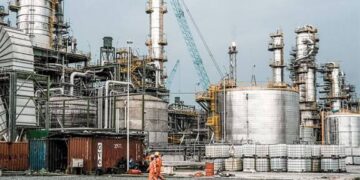
He said the company has begun an expansion programme that will more than double its refining capacity from 650,000 barrels per day (bpd) to 1.4 million bpd within the next three years.
He explained that expansion will be executed through a strategy designed to fast-track delivery by duplicating existing refinery infrastructure without altering core engineering.
The deal, signed in August last year, is part of the Federal Government’s drive to prioritise crude deliveries to the privately owned refinery, particularly in naira, to support energy security and stabilise domestic fuel supply.
The Naira-for-Crude policy is Nigeria’s initiative to sell crude oil to local refineries in Naira (not dollars) to stabilize the currency, reduce forex demand, cut refining costs, boost local refining, and achieve energy security, with the NNPCL supplying refineries like Dangote, who then sell refined products (petrol/diesel) back in Naira.
Bird said the current crude allocation to the refinery is between 30-40 per cent, citing the need to increase the same in the interest of Nigerians.
He said: “Effective execution of the naira-for-crude policy is critical to boosting domestic refining, stabilising fuel prices, and easing operational pressures.”
He spoke on the company’s intent to get quoted on the Nigerian Stock Exchange Market.
He said the company has begun an expansion programme that will more than double its refining capacity from 650,000 barrels per day (bpd) to 1.4 million bpd within the next three years.
He explained that expansion will be executed through a strategy designed to fast-track delivery by duplicating existing refinery infrastructure without altering core engineering designs.
He said: “Once engineers begin to tinker with designs, projects often return to prolonged engineering stages. Our approach avoids that,” Bird explained.
He expressed confidence that the expansion would be completed within three years, citing the extensive groundwork already carried out at the Lekki site. He also spoke on project milestones, saying the procurement of long-lead items would begin immediately, with completion targeted for the first quarter of 2026, while site preparation and piling works are expected to commence before the end of January 2025.
He said: “The remarkable thing about this site is the foresight of Aliko Dangote,” he said, adding, “The land has already been reclaimed, raised and prepared. Much of the pre-investment that typically delays projects has already been done.” He added that steelwork for the expansion could begin emerging from the ground before the end of this year, reinforcing confidence in the project timeline.
According to him, the refinery would continue to prioritise local capacity development, stressing the importance of upskilling Nigerian workers and deepening domestic technical expertise as the facility expands. He highlighted the refinery’s flexibility, noting that 100 per cent of its crude feedstock is imported by sea, giving it the ability to process a wide range of crude grades and intermediate feedstocks.
“This is not a traditional refinery tied to a single pipeline or crude stream,” he said, adding, “We can process Nigerian grades, alternative crudes, intermediate feedstocks, and blending components. That flexibility is what guarantees security of supply.”
“We will not re-engineer or redesign. This allows us to move directly into procurement and construction,” he added.
He expressed confidence that the expansion would be completed within three years, citing the extensive groundwork already carried out at the Lekki site.
He spoke on project milestones, saying the procurement of long-lead items would begin immediately, with completion targeted for the first quarter of 2026, while site preparation and piling works are expected to commence before the end of January 2025.
He said: “The remarkable thing about this site is the foresight of Aliko Dangote,” he said, adding, “The land has already been reclaimed, raised and prepared. Much of the pre-investment that typically delays projects has already been done.”
He added that steelwork for the expansion could begin emerging from the ground before the end of this year, reinforcing confidence in the project timeline.
According to him, the refinery would continue to prioritise local capacity development, stressing the importance of upskilling Nigerian workers and deepening domestic technical expertise as the facility expands.
He highlighted the refinery’s flexibility, noting that 100 per cent of its crude feedstock is imported by sea, giving it the ability to process a wide range of crude grades and intermediate feedstocks.
“This is not a traditional refinery tied to a single pipeline or crude stream,” he said, adding, “We can process Nigerian grades, alternative crudes, intermediate feedstocks, and blending components. That flexibility is what guarantees security of supply.”
He explained that the refinery’s advanced conversion units — which he described as the plant’s “moneymakers” — enable the production of high-quality fuels that meet market specifications.
Despite not yet operating at full nameplate capacity, Bird said the refinery has consistently delivered finished products safely and reliably, even while undergoing planned maintenance.
“We have built enough resilience into the system to take individual units offline for maintenance and still meet market demand,” he said, adding that the refinery supplied over 50 million litres of Premium Motor Spirit (PMS) daily throughout the festive season.
He stated that the refinery currently produces between 50 and 52 million litres of PMS per day, with an average daily truck-out volume of about 50 million litres.