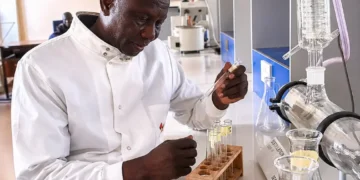
















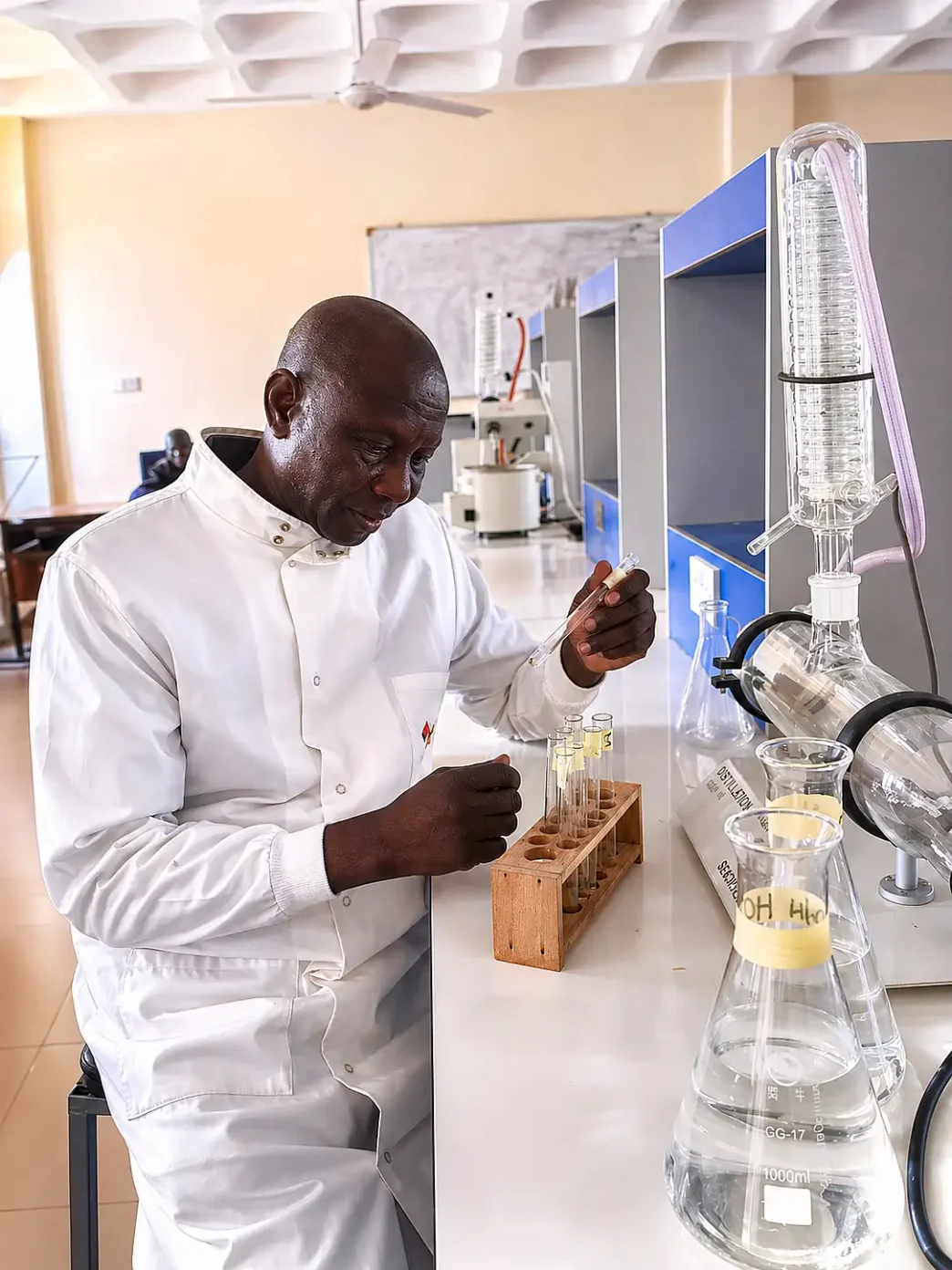


Professor Isaac John Umaru, a medical biochemist and Deputy Provost of the College of Health Sciences at the university, recently announced the discovery of a potential anti-cancer compound isolated from Cannabis sativa. The compound, named Kwagheticin, reportedly demonstrated stronger binding affinity in early molecular simulations than doxorubicin, one of the world’s most widely used chemotherapy drugs.
What makes this development extraordinary is not merely the science behind it, but the environment in which it emerged.
This was not the product of a billion-dollar pharmaceutical laboratory in Europe or North America. It was not driven by multinational corporate investment or state-backed scientific infrastructure. According to available reports, Professor Umaru and his wife personally financed much of the research from their own salaries, working within the constraints familiar to many Nigerian academics: inadequate funding, limited laboratory infrastructure, and almost nonexistent institutional support for advanced medical research.
That reality alone transforms this story from a scientific announcement into a profound commentary on African innovation, resilience, and neglected potential.
A Discovery Emerging from a National Health Emergency
Nigeria’s cancer burden has become one of the gravest public health crises on the continent.
The country records tens of thousands of cancer deaths annually, while access to treatment remains severely limited. Breast cancer, prostate cancer, cervical cancer, lymphoma, and leukemia continue to claim lives at alarming rates, often because diagnosis comes late and treatment remains financially inaccessible for the majority of patients.
With only a limited number of functional cancer treatment centres serving a population exceeding 200 million people, countless Nigerians are forced into devastating out-of-pocket healthcare spending. Many families sell assets, crowdsource funds, or simply abandon treatment altogether.
It is within this healthcare reality that Professor Umaru’s work acquires national significance.
His research is not merely an academic exercise. It is an attempt to confront one of Nigeria’s deadliest inequalities: the gap between disease and access to treatment.
Understanding the Science Without the Hype
Scientific caution is important.
Kwagheticin is not yet a cancer cure. It is not an approved drug. No clinical trials in humans have yet been completed. No regulatory authority has validated its therapeutic use. The compound remains at an early-stage research phase involving molecular docking studies and preliminary laboratory analysis.
Still, the findings are scientifically noteworthy.
Cancer cells rely heavily on an enzyme known as topoisomerase II, which helps manage DNA replication during rapid cellular division. Blocking this enzyme is already a recognised strategy in oncology, and drugs such as doxorubicin and etoposide work partly through this mechanism.
Professor Umaru’s team reports that Kwagheticin demonstrated a binding affinity score of minus 9.5 against topoisomerase II, compared to minus 9.1 for doxorubicin in simulation studies. In molecular docking science, a more negative score generally indicates stronger predicted interaction between a compound and its biological target.
While such findings do not guarantee clinical success, they do provide a compelling scientific basis for deeper investigation.
Importantly, experts in pharmacology understand that many promising compounds fail during later testing stages due to toxicity, instability, poor absorption, or ineffective performance in living systems. That is why rigorous preclinical and clinical trials remain essential.
But every globally recognised drug begins somewhere.
And for Kwagheticin, that beginning is Wukari.
The Cannabis Factor and the Politics of Perception
The use of Cannabis sativa as the source plant will inevitably generate controversy, misunderstanding, and sensationalism.
Yet modern pharmacological science has long established that cannabis contains hundreds of biologically active compounds with legitimate medical potential. Around the world, cannabis-derived therapies are already used in pain management, epilepsy treatment, and cancer-related symptom control.
Professor Umaru’s work does not claim that smoking cannabis cures cancer. Rather, his team reportedly isolated a distinct compound from the plant and subjected it to scientific analysis using recognised molecular methodologies.
That distinction matters.
Scientific medicine routinely derives powerful drugs from plants once regarded as ordinary, dangerous, or controversial. Aspirin emerged from willow bark. Morphine came from opium poppy. Quinine was derived from cinchona bark. Nature has historically served as one of medicine’s greatest laboratories.
The real question, therefore, is not whether the source plant carries social controversy, but whether the compound itself can withstand scientific scrutiny.
A Reflection of Africa’s Untapped Scientific Capacity
Perhaps the most important dimension of this story is what it reveals about African scientific potential.
For decades, African researchers have worked within systems that underfund science, undervalue research, and often force talented scientists into migration or abandonment of promising work. Universities struggle with obsolete equipment, irregular grants, and bureaucratic neglect. Research breakthroughs frequently die quietly before reaching global attention.
Yet despite these obstacles, discoveries continue to emerge from African laboratories.
Professor Umaru’s work is a reminder that intellectual capacity has never been Africa’s primary limitation. Infrastructure, investment, and sustained policy support have been the greater barriers.
The uncomfortable truth is that many developing nations consume imported scientific solutions while failing to adequately invest in indigenous research ecosystems capable of producing their own.
If properly supported, validated, and expanded, discoveries like Kwagheticin could become more than scientific achievements. They could help reposition African universities from passive consumers of global science to active contributors to global medical innovation.
What Happens Next Matters Most
The next phase will determine whether this breakthrough evolves into a transformative medical contribution or becomes another forgotten African discovery lost to poor institutional support.
For Kwagheticin to advance meaningfully, several things must happen:
Independent peer review and publication of the research data.
Expanded preclinical testing to assess toxicity and biological activity.
Regulatory oversight and ethical evaluation.
Strategic funding partnerships.
Collaboration with oncology researchers and pharmaceutical experts.
Government and institutional support for long-term development.
Without these structures, even the most promising discoveries struggle to survive.
Nigeria has often celebrated innovation rhetorically while failing to build systems capable of sustaining it. This moment offers an opportunity to do differently.
More Than a Scientific Story
At its core, this is not merely a story about cannabis, chemistry, or molecular docking.
It is a story about persistence inside neglect.
It is the story of Nigerian scientists conducting globally relevant research under conditions that would discourage many others. It is the story of a country facing a mounting cancer crisis while still underinvesting in scientific infrastructure. And it is the story of what becomes possible when intellectual determination refuses to surrender to institutional limitation.
Whether Kwagheticin ultimately succeeds or fails in the long journey of drug development, Professor Umaru’s work has already accomplished something significant: it has forced attention toward the possibility that world-class scientific innovation can emerge from places too often excluded from global research conversations.
And perhaps that is the deeper lesson from Wukari.
Sometimes the future of medicine begins far away from the world’s richest laboratories.