
















The official declaration of Honourable Abubakar Umar Abdullahi (AUA) for the Federal Capital Territory (FCT) Senatorial Seat may have done more than merely signal another aspirant entering the race. It may have fundamentally altered the political conversation ahead of the 2027 general elections.
For weeks, political discussions within the FCT had largely revolved around familiar calculations — established structures, entrenched interests, long-standing political figures, and traditional influence networks. But with AUA’s formal declaration before APC executives and stakeholders in Bwari Area Council, a new narrative appears to be emerging: the clash between old political dominance and a rising grassroots-driven movement built around performance.
At the centre of that shift is the Executive Chairman of Abaji Area Council himself — a politician whose growing influence within the FCT continues to attract both admiration.

AUA’s political rise has not occurred in isolation.
Having first emerged as Chairman of Abaji Area Council in 2022 and later securing re-election under the platform of the All Progressives Congress (APC), he has steadily built a reputation as one of the more visible grassroots political figures within the FCT political ecosystem.
Observers point to his ability to maintain political relevance beyond Abaji — traditionally viewed as one of the quieter area councils in the territory — as evidence of a carefully cultivated grassroots structure.
His administration in Abaji has consistently highlighted projects tied to rural infrastructure, community welfare, healthcare outreach, road rehabilitation, electrification, and educational support. His tenure featured initiatives such as free medical outreaches, solar streetlight installations, rural road grading, transformer installations, water projects, and support schemes for workers and vulnerable residents.

To supporters, those projects now form the foundation of his argument that the FCT deserves representation focused on development rather than symbolic empowerment politics.
Perhaps the most politically significant aspect of AUA’s declaration was not merely the announcement itself, but where it happened and the tone it adopted.
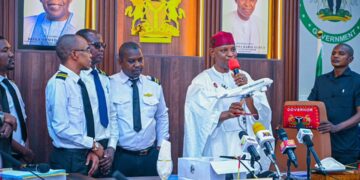
Standing before APC ward and local government executives in Bwari Area Council, AUA framed his campaign around what he repeatedly described as “quality representation” and a rejection of “borehole politics.”
The phrase was not accidental.
Within Nigeria’s political vocabulary, “borehole politics” has increasingly become shorthand for low-impact constituency projects often criticized as insufficient compared to the scale of public expectations. By publicly distancing himself from that style of representation, AUA appears to be positioning his campaign around large-scale infrastructure and federal project attraction.
“If given the mandate, I will not be a borehole senator,” he declared, promising instead to pursue multi-billion-naira developmental projects for the FCT.
Politically, the message was strategic.
It sought to elevate the debate from token constituency interventions to broader conversations around infrastructure, investment, and territorial development — themes increasingly resonating among younger voters and urban political observers within the FCT.
One recurring theme throughout the declaration event was the tension between grassroots mobilization and entrenched political structures.
AUA repeatedly stressed that elections are won through “numbers” and direct engagement with voters, arguing that no aspirant could afford to rely solely on assumed popularity or elite endorsements.
That messaging reflects an emerging reality within FCT politics.
Unlike previous election cycles where political heavyweights often dominated through established patronage systems, recent electoral patterns within the territory suggest increasing volatility and voter independence, especially at the grassroots level.
His ally, Honourable Shekwolo Audi, amplified that sentiment during the gathering when he dismissed claims that some politicians controlled multiple chairmen and structures. He argued instead that political outcomes are increasingly shaped by public sentiment and voter conviction.
The remarks, though clearly political, underscore a broader struggle within the APC ahead of the primaries — a contest between established influence blocs and newer actors seeking to redefine power within the party.
AUA’s entry into the race also adds another layer to the internal calculations within the APC in the FCT.
The ruling party remains one of the dominant political forces within the territory, particularly after strong performances in several area council elections.
However, beneath that electoral strength lies a complex web of competing loyalties, ambitions, and alignments ahead of the senatorial primaries.
By openly questioning the developmental record of unnamed political opponents and accusing certain actors of previously opposing President Bola Ahmed Tinubu before seeking political advantage under the APC, AUA signaled that the coming primary contest could become deeply ideological and confrontational.
His insistence on party loyalty and grassroots legitimacy appears designed to appeal both to APC loyalists and to voters frustrated by what they perceive as recycled political leadership.
Another factor shaping public interest around AUA’s candidacy is generational symbolism.
Critics may dismiss him as “just a boy,” as referenced during the declaration event, but supporters appear to be embracing that characterization differently — seeing it instead as evidence of youthful political energy and a break from traditional power hierarchies.
Across Nigeria, younger political actors are increasingly framing themselves as alternatives to long-standing political establishments. While age alone rarely determines electoral outcomes, the symbolism of generational transition continues to carry political value, especially among urban voters and younger demographics.
AUA’s campaign messaging appears carefully tailored toward that mood: energetic grassroots engagement, direct voter interaction, infrastructure-driven promises, and a rejection of politics built solely on patronage.
Still, the path to the FCT Senate remains highly competitive.
The FCT occupies a uniquely strategic political position as the nation’s capital, with a voter base that combines urban professionals, indigenous communities, civil servants, traders, youths, and rural populations spread across the six area councils — AMAC, Bwari, Abaji, Gwagwalada, Kuje, and Kwali.
Winning such a seat requires far more than popularity in one local government.
It demands coalition-building, sustained grassroots penetration, party negotiation, and the ability to survive intense political scrutiny.
For AUA, the immediate challenge lies in converting growing visibility into a territory-wide political movement capable of securing victory at the APC primaries and beyond.
Yet one thing appears increasingly clear: his declaration has already succeeded in repositioning the conversation.
The debate is no longer merely about who wants the FCT Senate seat.
It is now also about what kind of representation the FCT truly wants.
Suleiman Jibrin Aliyu is a member of AUA Support Forum and based in Bwari Area Council, Abuja.