

















By Bashir Bello, Abuja.
The Dangote Group has called on Nigeria to intensify local manufacturing, reduce dependence on imports and build the productive capacity required to achieve sustainable economic growth and resilience.

The Group said Nigeria’s long-term economic survival would depend on its ability to produce competitively for domestic consumption while developing the capacity to export to regional and global markets.
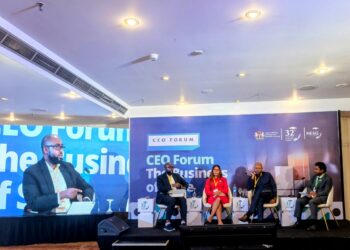
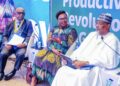
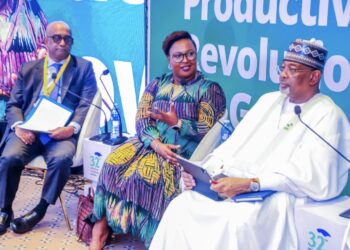
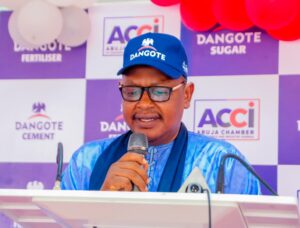
Regional Director and Senior Adviser to the President, Dangote Group, Hajiya Fatima Wali-Abdurrahman, made the call while addressing a packed audience at the 21st Abuja International Trade Fair. She was represented at the event by the Group General Manager, Bello Dan-Musa.
She said true economic resilience was not merely about surviving periods of economic hardship, but about building the capacity and institutions required to reduce dependence on external sources.
“Nigeria’s economic resilience will ultimately depend on a fundamental choice: whether we continue to import what we can produce, or build the capacity to produce, compete and export,” she said.
Hajiya Fatima highlighted Dangote Group’s investments across critical sectors of the Nigerian economy, including cement, fertiliser, sugar, petrochemicals and petroleum refining, as examples of how sustained investment in local production can transform industries, create jobs and strengthen domestic value chains.
She noted that Dangote’s investments have helped transform Nigeria from a major cement-importing country into a cement-producing and exporting nation, while generating employment and supporting thousands of businesses across its value chains.
According to her, the same philosophy underpins the Group’s investments in other strategic sectors, particularly the petroleum industry.
She disclosed that the Dangote Petroleum Refinery, currently operating at a capacity of about 700,000 barrels per day, is being positioned for further expansion, with the ambition of reaching 1.4 million barrels per day by 2030.
She also highlighted the Group’s broader expansion strategy across Africa, including plans for a new refinery project in Lamu, Kenya, describing such investments as part of a long-term commitment to strengthening Africa’s industrial and energy capacity.
She said the objective was not simply to build individual businesses, but to develop industries capable of meeting Africa’s growing demand while reducing the continent’s dependence on imported products.
On taxation, Hajiya Fatima stressed the importance of creating a predictable and transparent tax environment that would support economic growth and encourage businesses to invest for the long term.
She said taxation remained essential to funding infrastructure and public services, but warned that tax policies must be structured in a manner that does not undermine enterprise, investment and competitiveness.
“When businesses can plan with confidence, taxation strengthens public revenue without discouraging investment, innovation or competitiveness,” she said.
She therefore called for greater policy predictability and transparency, noting that businesses require a stable operating environment to make long-term investment decisions, expand production and create employment.
The Dangote representative also highlighted the ongoing Initial Public Offering of Dangote Petroleum Refinery and Petrochemicals FZE, describing it as an opportunity for Nigerians to participate directly in the ownership of one of Africa’s most significant industrial investments.
The offer comprises 4.1 billion shares at ₦525 per share and is scheduled to close on October 13, 2026.
She encouraged Nigerians to take advantage of the opportunity, describing broader citizen participation in industrial ownership as an important step towards deepening financial inclusion and ensuring that Nigerians have a stake in the country’s industrial transformation.
Hajiya Fatima said the Group’s Vision 2030, which targets the creation of a $100 billion business empire, goes beyond financial growth.
She said the vision is anchored on producing what Africa consumes, creating opportunities for the continent’s growing population, developing local talent and building African companies capable of competing successfully on the global stage.
She stressed that Africa’s future economic strength would depend largely on its ability to develop competitive industries, strengthen local supply chains and retain more value within the continent.
The First Deputy President of the Abuja Chamber of Commerce and Industry (ACCI), Prof. Adesoji Adesugba, commended Dangote Group for its continued support for the Abuja International Trade Fair, describing the company as a major backbone of the Fair and a demonstration of the capacity of Nigerian industry to compete globally.
He said the Chamber looked forward to deepening its partnership with Dangote Group and exploring additional areas of collaboration that would deliver greater benefits to businesses, consumers and the Nigerian economy.
Prof. Adesugba also called for stronger collaboration between public institutions and the private sector to promote trade, investment, innovation and sustainable economic development.
He noted that partnerships between institutions and businesses were critical to creating an enabling environment for enterprise and unlocking Nigeria’s economic potential.
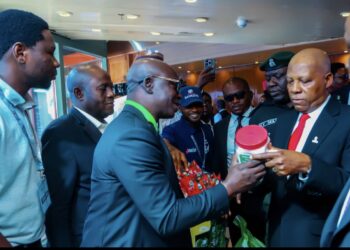
The colourful Dangote Special Day event attracted a large turnout of industry leaders, business partners, government officials, investors, members of the business community and other stakeholders participating in the 21st Abuja International Trade Fair.