














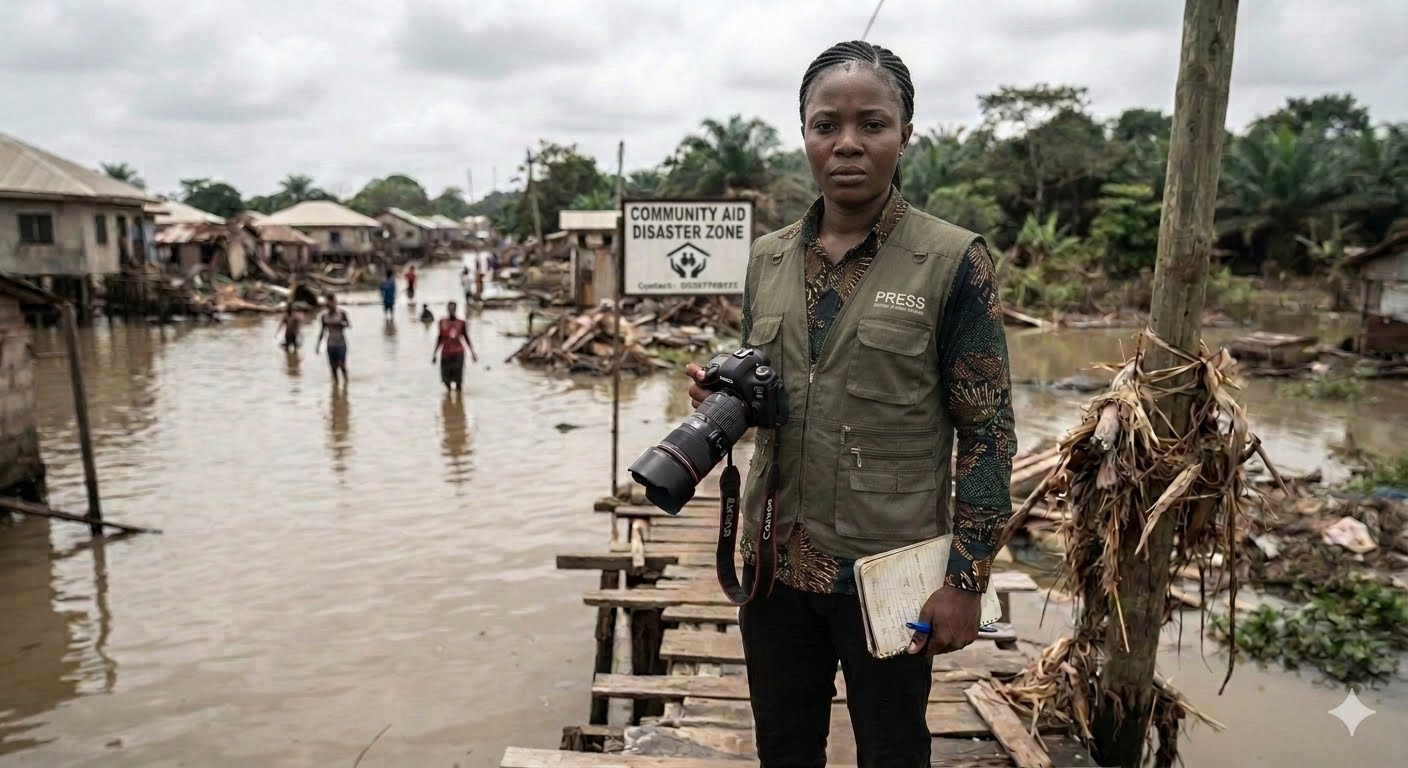
There is a peculiar contradiction at the heart of Africa’s environmental crisis.

The consequences are becoming
impossible to ignore, yet those trying to document them can sometimes struggle to make themselves heard.
A farmer loses a harvest to flooding.

A fisherman watches a polluted river become increasingly unusable.
A family leaves a community threatened by erosion.
A northern settlement watches farmland slowly surrender to desertification.
A coastal community faces the relentless advance of the sea.
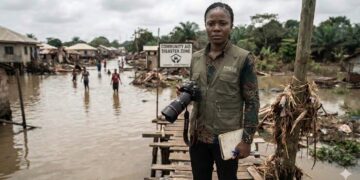
And somewhere nearby, a journalist is trying to tell that story.
That journalist may be working with little money, limited equipment and inadequate protection. Worse, when environmental reporting touches powerful interests—oil, mining, logging, land, infrastructure, corruption or public spending—the journalist may discover that reporting the environmental story can also mean reporting a political and economic story.
That is where the real danger begins.
Climate change is no longer tomorrow’s problem
Nigeria’s own climate-risk assessment warns that rising temperatures, changing rainfall patterns, drought, desertification, flooding and coastal erosion are increasing threats to national development. The country’s climate authorities describe climate change as a serious challenge to development.
The consequences are not confined to the environment.
When floods destroy farms, they affect food prices.
When roads and bridges are washed away, they disrupt commerce.
When communities lose homes and livelihoods, displacement increases.
When farmers and pastoral communities face worsening pressure over land and water, social tensions can deepen.
When environmental degradation destroys fishing grounds or agricultural land, poverty becomes harder to escape.
Climate change, therefore, is not merely an environmental story.
It is an economic story. A food-security story. A public-health story. A migration story. A security story. And increasingly, a political story.
Nigeria’s experience with flooding illustrates the scale of the challenge.
NEMA has reported substantial human and economic losses from major floods, while the Federal Government has increasingly emphasised early warning, preparedness and anticipatory action rather than waiting for disasters to happen before responding.
That shift is important.
But preparedness must go beyond emergency relief.
Nigeria needs stronger drainage and flood-control systems, better urban planning, protection of wetlands and waterways, climate-smart agriculture, stronger environmental regulation, reliable early-warning systems and long-term investment in resilient
infrastructure.
The Niger Delta is a warning from the past
Few places demonstrate the connection between environment and development more clearly than the Niger Delta.
The UNEP assessment of Ogoniland documented extensive contamination affecting land, groundwater, surface water, vegetation, air quality and public health. More than 4,000 samples were collected from over 200 locations during the assessment.
The lesson is profound.
Environmental degradation can outlive the political decisions and commercial activities that helped create it.
Communities remain with damaged ecosystems.
Families inherit economic consequences.
Young people inherit unresolved grievances.
And governments inherit expensive restoration responsibilities.
The environmental question is therefore also a question of justice between generations.
And who tells the story?
This is where environmental journalism becomes indispensable.
A journalist who investigates an oil spill is not simply reporting pollution.
He or she may be asking:
Who caused it?
Who is responsible?
Who knew?
Who failed to act?
Who is paying for the damage?
Where is the public money going?
And what happens to the affected community?
That is accountability journalism.
Recent research by the International Press Institute documented 26 attacks and threats against environmental journalists in sub-Saharan Africa between October 2025 and March 2026.
Journalists investigating illegal mining, logging, oil management and natural-resource exploitation were particularly exposed.
IPI has also highlighted the threat of strategic lawsuits against public participation—SLAPPs—against environmental and climate journalists, including in Nigeria and other African countries.
The danger is therefore not theoretical.
When environmental journalism is intimidated, society loses more than a reporter.
It loses information.
It loses scrutiny.
It loses an early warning system.
And ultimately, citizens lose part of their ability to hold institutions and powerful interests accountable.
Africa cannot afford silent environmental journalism
The African Union has already recognised climate change as a major continental challenge through its Climate Change and Resilient Development Strategy and Action Plan 2022–2032.
But continental strategies require information.
Researchers need data.
Policymakers need evidence.
Communities need warnings.
Citizens need credible journalism.
And journalists need the freedom and security to investigate.
This is why environmental reporting deserves a much higher place in Africa’s media priorities.
Newsrooms should invest in specialised environmental desks.
Journalists should receive training in climate science, data journalism and environmental law.
Media organisations should strengthen legal support and digital security for reporters working on sensitive investigations.
Governments should recognise that criticism is not an environmental crime.
Companies should understand that scrutiny is part of responsible corporate citizenship.
And civil society organisations should build stronger networks to protect journalists who expose environmental wrongdoing.
The opportunity inside the crisis
There is another side to this story.
Africa’s environmental challenges also represent enormous opportunities for innovation.
Renewable energy.
Climate-smart agriculture.
Water technology.
Waste management.
Green construction.
Sustainable transport.
Reforestation.
Carbon markets.
Environmental data and satellite monitoring.
Young Africans can build businesses and careers around these emerging sectors.
Nigeria, with its enormous population, entrepreneurial culture and technological talent, can become a major African centre for climate innovation if environmental policy is connected to investment, research and enterprise.
The challenge is to move from disaster response to resilience, from environmental rhetoric to enforcement, and from damage assessment to prevention.
The journalist, the citizen and the future
The environmental journalist may sometimes appear to be standing alone with a notebook, camera or microphone.
In reality, that journalist may be standing between the public and an environmental disaster that nobody wants to discuss.
Africa needs such journalism.
Nigeria needs it.
And journalists who investigate environmental hazards need protection—not intimidation.
The continent cannot build a sustainable future while silencing those documenting the damage.
The message should therefore be simple:
Protect the environment. Protect the communities. Protect the journalists who tell the story.
Because sometimes the first warning of an environmental disaster does not come from a government report.
It comes from a journalist who went there, looked carefully, asked difficult questions—and refused to look away.