

















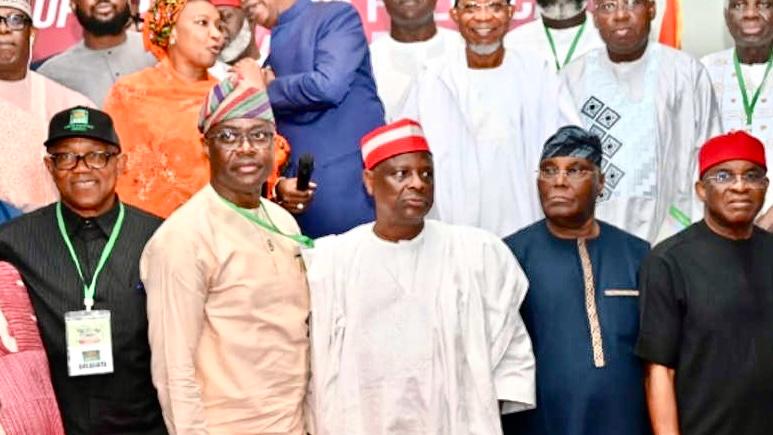
There is nothing undemocratic about opposition politicians uniting against President Bola Ahmed Tinubu and the APC in 2027. But chanting “Tinubu must go” under one rented roof is not the same as building a coalition with a coherent plan to make Nigeria work. The problem with Lukman’s G100 is not its goal, but it is whether it can work.

Who Gets the Ticket?
The G100’s stated objective is to unite major opposition parties and candidates behind a common platform and a single presidential candidate to defeat the APC in 2027. But this raises the hardest question: who gets the ticket?

Atiku Abubakar wants to be President. Peter Obi has his own ambition, as do other opposition figures with their own structures and support bases; a difficulty Salihu Lukman himself has acknowledged.
Nigeria Has Seen This Before
Nigeria’s political history is full of alliances and coalitions that promised opposition unity but failed to achieve lasting political integration.
From the First and Second Republics to the APP-AD arrangement of 1999 and the Coalition of United Political Parties (CUPP) ahead of the 2019 election, the lesson is broadly the same: political parties can sign agreements much faster than they can build a common political organisation.
The best example is the APC in 2013. It was not formed just because the opposition agreed the PDP must go. ACN, CPC, ANPP and a faction of APGA surrendered their identities to create a new party with common structures, power-sharing, platform and campaign. They did not keep old identities while voting for each other. They built something new that defeated the PDP in 2015.
This is the fundamental lesson G100 must understand. It appears to want the result of the APC merger without reproducing the organisational process that made that result possible.
Unity Without Integration
G100 wants parties to keep their separate identities and ambitions while acting as one, which leaves the fragmentation it claims to solve intact. If supporters of Atiku or Obi will not enthusiastically back the winner, it has not removed fragmentation, only postponed it until after selection, which is more dangerous.
The 2023 Lesson
It is true that opposition fragmentation helped the APC in 2023. But the lesson should not simply be that putting Atiku, Obi and Kwankwaso together would automatically produce victory. Each candidate has a distinct political constituency, identity, history, loyalties and expectations.
Votes do not automatically transfer from one politician to another because political leaders sign an agreement.
The real challenge is to turn separate political constituencies into one motivated and disciplined electoral coalition.
Where Is the Alternative?
Perhaps the most important question G100 has not answered is: what is it offering Nigerians beyond taking power?
What will it do differently about insecurity, unemployment, inflation, food prices, electricity, education, healthcare, jobs, corruption and the economy? These cannot be answered with slogans.
A message of simply “APC must go” is a change of leadership, not a political alternative. The APC succeeded in 2015 not just by merging, but by presenting itself as a different direction. Whether one agrees with its subsequent record in government or not, millions of Nigerians believed that the APC represented a change. A new machine without a new programme is just a new vehicle carrying old politics.
Nigerians must also ask: is the G100 for Nigeria’s problems or for opposition politicians’ problems? Ordinary people want to know what will change in their lives, not just how the coalition will win.
Finally, there are questions of credibility and timing. Any mediator must command trust, and suspicion of bias will break it. The APC started its work long before 2015; the G100 is trying to reconcile entrenched ambitions much closer to 2027. That is a far harder task.
What G100 Must Do
If G100 is serious, it must move beyond meetings and summits. It needs a transparent method for picking its candidate, a binding agreement, a common manifesto, a unified campaign, and a credible system for sharing power and settling disputes. Nigerians would also need to know what it will do with power, not just who it is against.
But even that is not enough; it must tell Nigerians what it will do with power. Do not just say who you are against; say what you are for. Do not just announce a coalition; present a programme that shows how you will make lives better.
Without these, G100 has not learnt the lesson of 2015. The APC won because it surrendered identities to build one party. G100 wants the victory without the sacrifice, and without that, it will only make headlines before collapsing at the ballot.
A Word of Caution to Nigerians
Beyond its structural flaws, Nigerians must be wary. Politicians often weaponize hardship and hope, while their quest for power remains transactional. Some of the loudest voices preaching unity today are alleged to be quietly negotiating their own relevance and ensuring the ruling party’s return.
Nigerians must not be fooled by this theatre. A more patriotic course for the G100 would be to drop the illusion of displacing the APC in 2027 and instead engage the government on good governance and service delivery. The energy spent on a fragmented coalition would be better used pushing for a unity government after President Tinubu’s re-election; one that stabilizes the polity and sustains difficult reforms.
Hon. Isma’ila Aliyu Makarfi
Email: [email protected]